
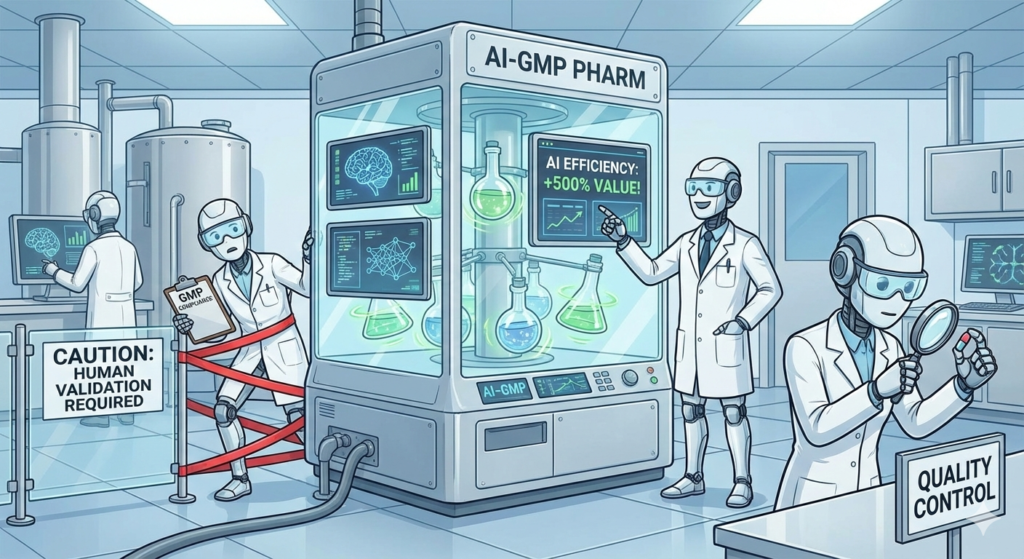
AI Has Moved From Experiment to Infrastructure
In 2025, artificial intelligence (AI) is no longer confined to innovation labs or pilot projects in biotech manufacturing. It is increasingly embedded in core operational workflows, from process optimisation and predictive maintenance to quality monitoring and supply resilience.
This shift has not gone unnoticed by regulators.
In July 2025, the European Medicines Agency (EMA) released a draft Annex 22 on Artificial Intelligence, signalling formal GMP expectations for AI-enabled systems. Earlier in the year, the FDA published draft guidance outlining how AI may support regulatory decision-making across the drug lifecycle, including manufacturing.
The message from both sides of the Atlantic is clear:
AI can create real manufacturing value but only if it is deployed within a disciplined GMP framework.
This article explores where AI genuinely delivers impact in biotech manufacturing, where regulatory caution is required, and how companies can adopt AI responsibly without compromising compliance, data integrity, or inspection readiness.
Why 2025 Became a Regulatory Turning Point for AI
Until recently, AI adoption in manufacturing outpaced regulatory clarity. That gap began to close in 2025.
Key developments include:
EMA Draft Annex 22 (Artificiall Intelligence)
Introduced as a supplement to the EU GMP Guide, Annex 22 focuses primarily on static, deterministic AI/ML models used in GMP-relevant activities. It emphasizes:
• Clear intended use
• Data quality and governance
• Model validation and lifecycle oversight
• Adaptive or self-learning systems are restricted in high-impact GMP contexts
FDA Draft Guidance on AI for Regulatory Decision-Making
The FDA outlined a risk-based credibility framework applicable across development and manufacturing, stressing:
• Transparency of training data
• Performance monitoring
• Lifecycle management plans
• Early engagement with regulators for novel use cases
Global convergence via PIC/S and ICH principles
These efforts reflect broader alignment around ICH Q9(R1): risk-based thinking, proportional controls, and accountability regardless of technology novelty.
Together, these signals mark AI’s transition from “innovation opportunity” to regulated manufacturing capability.
Where AI Creates Real Manufacturing Value
Not all AI applications carry the same risk or deliver the same return. In practice, the most successful deployments in 2025 share a common trait: they address well-defined operational problems rather than abstract transformation goals.
1. Process Optimization in Complex Modalities
AI-driven analytics can detect subtle relationships in multivariate process data that traditional statistical tools often miss. This is particularly valuable in:
• Inhalation platforms (e.g. particle size distribution, device–formulation interaction)
• Biologics and advanced therapies with narrow process windows
Used correctly, AI improves consistency, reduces batch variability, and supports scalable manufacturing.
2. Predictive Maintenance for Critical Equipment
By analysing equipment performance data (vibration, temperature, pressure trends), AI can anticipate failures before they occur. In 2025, manufacturers reported:
• Reduced unplanned downtime
• Improved asset utilisation
• Lower maintenance costs for high-value equipment
Importantly, predictive maintenance is typically considered lower GMP risk when it does not directly influence product release decisions.
3. Early Deviation and Anomaly Detection
AI models can flag emerging trends that may lead to OOS results or deviations. Often earlier than manual review. For advanced therapies, where small deviations can have outsized consequences, this early signal detection supports quality robustness.
Where GMP Caution Is Non-Negotiable
Despite its promise, AI introduces new compliance challenges that manufacturers must address explicitly.
Model Validation and Lifecycle Control
Under Annex 22 expectations, AI models must be:
• Fit for intended use
• Trained on representative, traceable data
• Subject to defined change control and performance monitoring
Self-learning or adaptive models are generally not acceptable for critical GMP decisions due to their unpredictable behaviour over time.
Data Integrity and Governance
AI systems amplify existing data risks. Poor-quality inputs, biased datasets, or incomplete audit trails can undermine model outputs and inspection credibility.
Regulators remain clear:
AI does not dilute data integrity expectations, it raises them.
Accountability and Human Oversight
Manufacturers retain full responsibility for GMP compliance, even when AI tools are:
• Cloud-based
• Vendor-supplied
• Embedded in third-party systems
Human oversight remains mandatory, particularly for decisions affecting product quality or patient safety.
Practical Steps for Responsible AI Adoption
For biotech and pharma organisations considering AI in manufacturing, a pragmatic path forward includes:
1. Start with risk classification
Align AI use cases with ICH Q9(R1) to determine validation depth and oversight requirements.
2. Pilot in non-critical areas first
Predictive maintenance and process monitoring often provide high value with manageable compliance complexity.
3. Strengthen data foundations
AI success depends on structured, governed, and traceable data—not algorithms alone.
4. Document lifecycle governance early
Regulators will expect clarity on model updates, retraining triggers, and performance drift monitoring.
5. Engage regulators proactively
Early dialogue reduces uncertainty and prevents misalignment during inspections.
Looking Ahead: AI as a Manufacturing Capability, Not a Shortcut
As final versions of Annex 22 and related guidance emerge in 2026, AI will increasingly be treated as part of standard GMP infrastructure rather than an exception.
Organisations that approach AI with discipline, clear use cases, robust data governance, and proportional control will gain operational resilience and scalability. Those that treat AI as a shortcut risk regulatory friction and delayed value realisation.
The opportunity is real. So is the responsibility.