
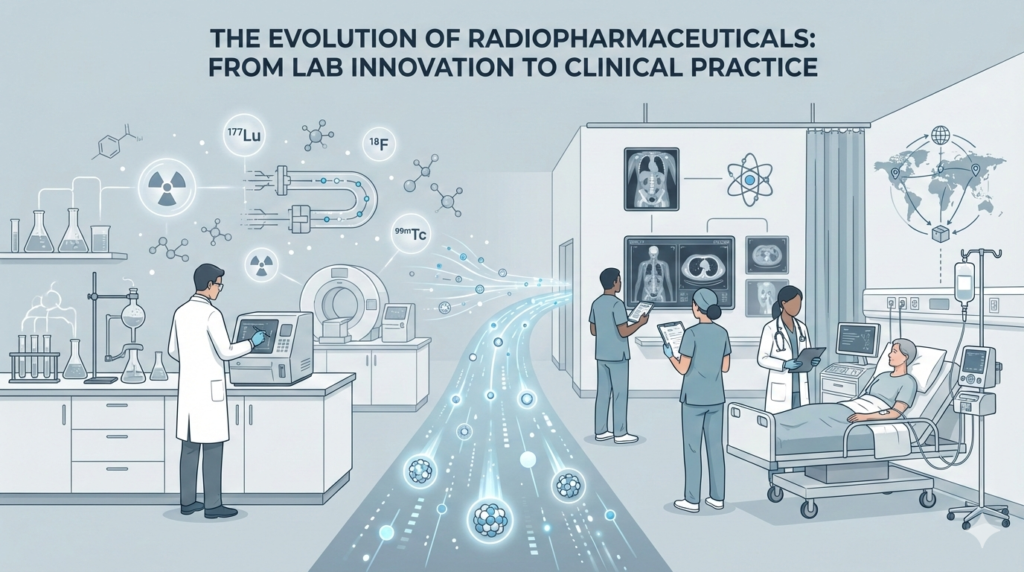
Radiopharmaceuticals innovation in 2026 have moved decisively beyond their historical niche in nuclear medicine. What was once a specialised diagnostic adjunct has become a central pillar of precision oncology, driven by the convergence of targeted vectors, radioactive isotopes, and increasingly sophisticated clinical protocols.
Yet as the field enters its next phase of growth, the industry’s primary constraint is no longer scientific validation. It is practical adoption.
The defining question for radiopharmaceuticals is shifting from “Does it work?” to “Can healthcare systems realistically deploy it at scale?”
From Scientific Breakthroughs to System-Level Reality
The past five years delivered undeniable momentum:
strong clinical data, renewed investor interest, and high-profile success stories across both diagnostic and therapeutic applications.
The global radiopharmaceutical market is now estimated at USD 7–11 billion, depending on scope and definition, with forecasts pointing to continued double-digit growth through the next decade. This expansion reflects genuine progress but also exposes the limits of current deployment models.
Outside of leading academic centres, adoption remains uneven. The reasons are increasingly consistent:
• capital-intensive infrastructure requirements
• specialised hardware dependencies
• tightly coupled production and administration workflows
• and limited tolerance for operational failure
As a result, system readiness, not molecular innovation, is becoming the true bottleneck.
Infrastructure Intensity as the Hidden Cost Driver
Radiopharmaceutical development has traditionally assumed the availability of advanced nuclear medicine infrastructure: cyclotrons, hot cells, shielded imaging suites, and highly trained personnel.
In practice, this assumption narrows the addressable market.
Healthcare systems, particularly beyond tier-one centres, are increasingly resistant to solutions that require new capital expenditure, bespoke installations, or rigid facility upgrades. Even when clinical value is well established, infrastructure-heavy approaches struggle to scale.
From a hospital and payer perspective, the total cost of adoption now includes:
• upfront capital investment
• workflow disruption
• staffing and compliance burden
• long-term operational risk
Innovation that ignores these realities faces friction, regardless of scientific merit.
Workflow Compatibility Is Becoming a Strategic Advantage
A clear shift emerging in 2025–2026 is the growing preference for radiopharmaceutical approaches that integrate into existing clinical pathways, rather than redefining them.
Solutions that align with established surgical, diagnostic, or nuclear medicine workflows benefit from:
• faster institutional approval
• lower training requirements
• reduced implementation risk
• broader geographic reach
By contrast, highly specialised modalities (however compelling scientifically) often remain confined to a small number of elite centres.
The implication is increasingly clear: clinical strength alone is no longer sufficient. Practical usability now carries equal strategic weight.
Cost, Access, and the Next Phase of Radiopharmaceutical Adoption
This recalibration is also visible at the policy and reimbursement level. In the United States, evolving frameworks under the Centers for Medicare & Medicaid Services reflect growing scrutiny not only of clinical outcomes, but of delivery efficiency and system cost.
Similarly, regulatory bodies such as the U.S. Food and Drug Administration and the European Medicines Agency are increasingly attentive to real-world feasibility, particularly for combination products and novel administration paradigms.
Taken together, these forces are nudging the field toward solutions that:
• minimise dependency on scarce or specialised infrastructure
• reduce logistical and operational complexity
• enable broader patient access without compromising safety
The future of radiopharmaceuticals will be shaped as much by where and how they can be used as by what they do biologically.
From Novelty to Sustainability: How Radiopharmaceutical Innovation Is Evolving
The theranostic promise “see what you treat, treat what you see” remains powerful. But in its next chapter, success will belong to approaches that respect the economic and operational constraints of real healthcare systems.
Radiopharmaceutical innovation is entering a period of maturation. The centre of gravity is shifting away from novelty and toward sustainability, scalability, and cost-aware design.
For developers, investors, and healthcare providers alike, the message is becoming unmistakable:
The most valuable advances will be those that deliver precision without requiring healthcare systems to reinvent themselves.