
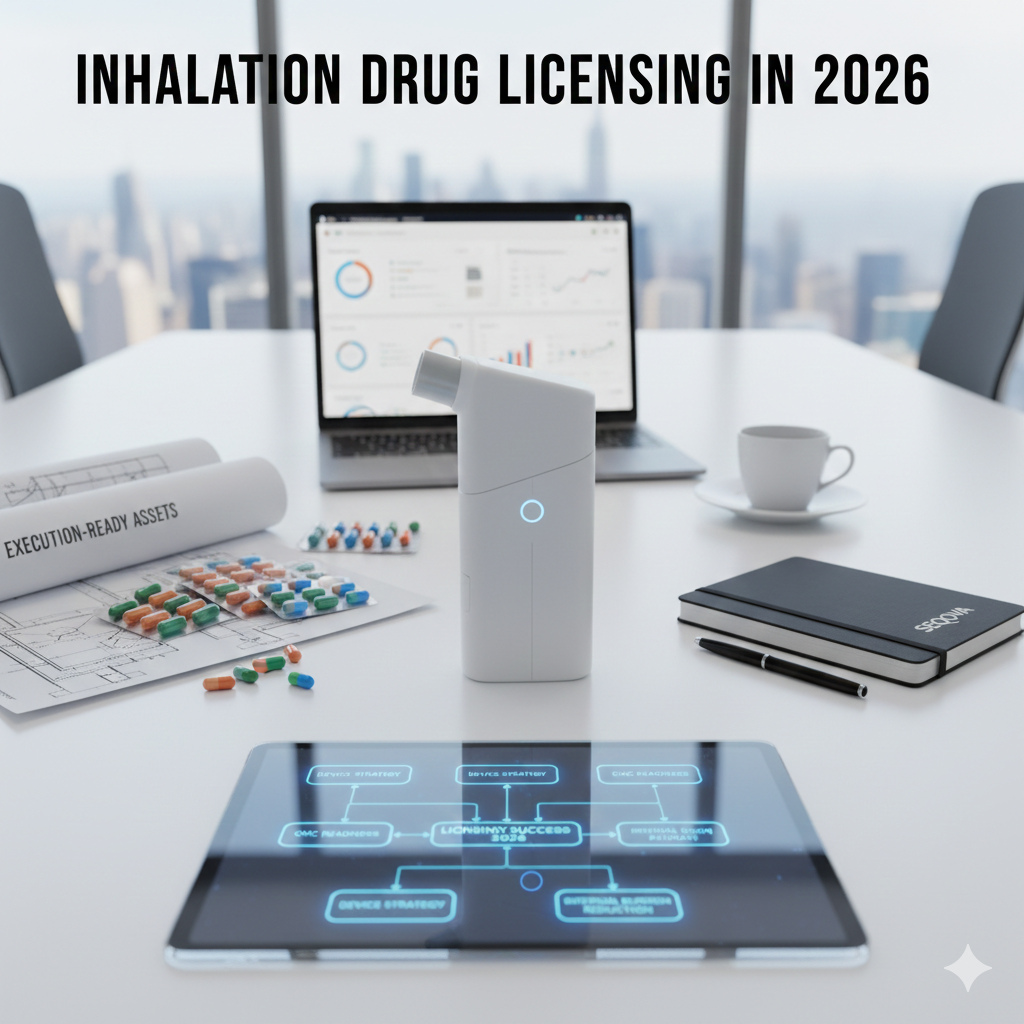
For years, inhalation drug licensing has been misunderstood.
It wasn’t deprioritized because it failed scientifically. It was deprioritized because the market rewarded novelty over execution. Biologics, gene therapies, and platform narratives dominated buyers’ attention, while inhaled programs, proven, regulated, and manufacturable, were seen as unexciting.
In 2026, that bias is being corrected.
Not because inhalation has changed, but because the licensing market has. As buyers face tighter capital discipline, internal execution constraints, and growing lifecycle gaps, the value of clarity, speed, and integration readiness has risen sharply. In that environment, inhalation drug licensing is re-emerging as a strategically efficient way to build portfolios without compounding risk.
This article examines why inhalation drug licensing is regaining relevance, how buyers are screening assets today, and what separates programs that move forward from those that quietly stall.
The 2026 Licensing Environment: Execution Beats Novelty
Licensing activity has not slowed, but it has become far more selective.
Across pharma and biotech, BD and portfolio teams are under pressure from three converging forces:
- Patent expiries and lifecycle gaps emerging between 2026–2030
- Capital discipline, with fewer speculative programs tolerated
- Internal execution constraints, particularly across CMC, manufacturing, and regulatory bandwidth
The result is a structural shift in buyer behavior. Assets are no longer evaluated primarily on how innovative they appear, but on how smoothly they can be integrated into existing organizations.
In this context, inhalation drug licensing benefits from something that many newer modalities lack: predictability. When execution risk becomes the primary filter, modalities with established regulatory expectations and manufacturing logic regain strategic appeal.
Why Inhalation Drug Licensing Is Strategically Attractive Again
The renewed interest in inhalation is not cyclical. It is structural.
Local Delivery With Durable Relevance
Inhalation enables targeted delivery with reduced systemic exposure, making it particularly well suited for chronic respiratory and fibrotic diseases. These are areas where long-term disease burden, payer scrutiny, and treatment adherence matter more than first-in-class claims.
For licensors and buyers alike, this translates into durable demand narratives rather than transient innovation cycles.
Manufacturing and CMC That Buyers Understand
Unlike emerging modalities, inhalation manufacturing risk is well characterized.
For BD teams, this reduces friction in three critical areas:
• Due diligence timelines
• Cost-of-goods forecasting
• Post-deal integration planning
In the context of inhalation drug licensing, this predictability matters. Assets built on established DPI formats and well-understood APIs allow buyers to assess execution risk earlier and with greater confidence. As a result, these programs often progress more efficiently through internal review, even when development is still ongoing.
In 2026, inhalation assets that demonstrate foresight across manufacturing and CMC are increasingly favored. Not because they are technically simple, but because they do not create unnecessary downstream burden for the licensee.
Portfolio Optionality Over Single-Asset Bets
Today’s licensing decisions are rarely about a single product.
Buyers are increasingly underwriting optionality:
• Lifecycle extensions
• Geographic expansion
• Line extensions
• Portfolio balancing across risk profiles
Inhalation drug licensing fits this mindset well. Programs built on known molecules and established delivery formats can support multiple strategic outcomes, making them easier to defend internally and more resilient to changing priorities.
What Buyers Screen for in Inhalation Drug Licensing (2026 Reality)
Despite renewed interest, many inhalation assets still fail to progress through licensing discussions.
The reason is rarely scientific. It is almost always strategic readiness.
In 2026, buyers consistently screen for four execution signals.
1. Device Strategy Is Resolved
Uncertainty around device choice, ownership, or long-term supply remains one of the fastest ways to stall a licensing conversation.
For inhalation drug licensing, buyers expect:
• A settled device strategy
• Clear freedom-to-operate
• Scalable manufacturing logic
Assets that enter discussions with unresolved device questions signal future friction. Regardless of clinical promise.
2. CMC Readiness Is Credible
The diligence question has changed.
It is no longer “Can this be scaled?”
It is “How much work will we inherit after signing?”
Assets that demonstrate early CMC foresight move faster through BD and portfolio committees, even at relatively early development stages.
3. Regulatory Logic Is Coherent and Aligned
In inhalation drug licensing, buyers do not expect regulatory novelty. They expect regulatory coherence.
Programs built on known APIs are assessed on whether their regulatory logic is:
• Defensible
• Aligned across regions
• Free of avoidable surprises
Assets that rely on unresolved or overly optimistic assumptions tend to stall. Not because they are impossible, but because they create decision risk.
4. The Asset Reduces Internal Execution Burden
In 2026, the most attractive licensing opportunities are those that simplify execution, not complicate it.
This is the execution premium.
Inhalation assets that arrive with clarity, rather than open questions, are easier to champion internally and more likely to progress from discussion to deal.
Positioning Inhalation Assets for Licensing: A Practical View
In today’s market, inhalation assets that progress most efficiently through licensing discussions tend to share a common profile.
They are typically built on well-characterized APIs, paired with established DPI formats, and targeted at indications with durable clinical and commercial demand. Rather than positioning themselves as innovation stories, these programs are framed as execution-ready licensing opportunities.
From a buyer’s perspective, this profile offers several advantages:
• Faster internal alignment and time to decision
• More predictable development and manufacturing risk
• Flexibility across multiple portfolios and lifecycle scenarios
This is the practical reality of inhalation drug licensing in 2026. Assets that emphasize clarity, readiness, and portfolio fit consistently outperform those that rely solely on novelty.
What This Means for Licensors in 2026
If you are preparing an inhalation asset for licensing, the key question is no longer:
“Is this interesting?”
It is:
“Is this easy for a buyer to say yes to?”
In 2026:
• Clarity beats complexity
• Execution beats ambition
• And inhalation drug licensing rewards assets that are prepared, not hyped
Inhalation may never be the loudest modality in the room. But for licensors and buyers operating under real execution constraints, it is becoming one of the most efficient and reliable paths to value.